
How to find the original of a slowed + reverb song
A slowed + reverb edit plays a song slower and lower, with echo added, so a recognition app often can't match it to the original. Four ways to find the song it came from, and when none will work.
A slowed + reverb edit plays a song slower and lower, with echo added. That is why a recognition app so often comes back empty: the edit no longer sounds like the original recording in its catalog. To find the song it came from, start with the credit and the lyrics, then use a tool that corrects the speed before it matches.
What a slowed + reverb edit changes
Slowing a recording down drops its tempo and its pitch together, the way a record played at the wrong speed sounds deeper. Reverb then smears the sound, so the sharp edges a fingerprint relies on get softer.
A recognition app identifies a song by its fingerprint: a compact description of how the recording sounds over time. The slowed edit’s fingerprint doesn’t line up with the original’s, so the app is effectively being asked about a recording it has never heard. If the slowed version was officially released, it can be in the catalog and match like any other track. Most edits in short videos weren’t released.
Nightcore and sped-up edits are the same problem in the other direction: faster and higher. See why sped-up songs are hard to identify.
1. Read the credit and the caption
Tap the sound on the video. Slowed edits are often posted under the song’s own name with “slowed” or “slowed + reverb” added, which gives you exactly what to search for. A link lookup reads the same credit: in TuneSnipe, sharing or pasting a TikTok, Reel or Short link is free, and the post’s video and audio are never downloaded.
2. Search the lyrics
Slowing a song down doesn’t change its words. If you can make out a line, search it in quotes. Heavy reverb can make words hard to catch, so try a line from where the vocal is clearest.
3. Correct the speed, then match
If the edit is the original played slower, the fix is to play it back at the speed it came from and match that. TuneSnipe Pro does this during a session: when a song isn’t recognised, it replays the last 8 seconds at corrected speeds from 0.8× to 1.33×, and learns which correction your feed needs. The bottom of that range covers an edit played at four fifths of the original speed. A catch found this way shows the speed it was identified at.
4. Keep it and try harder later
Some edits shift the pitch without changing the tempo, or pile on more effects. For music nothing could identify, TuneSnipe Pro can keep a 12 to 15 second clip in its Vault on your iPhone. Deep Snipe then retries it at 10 speeds, 4 tempos and 4 pitches, and listens for lyrics on the device. Clips can’t be exported, and they are deleted after 90 days if still unidentified.
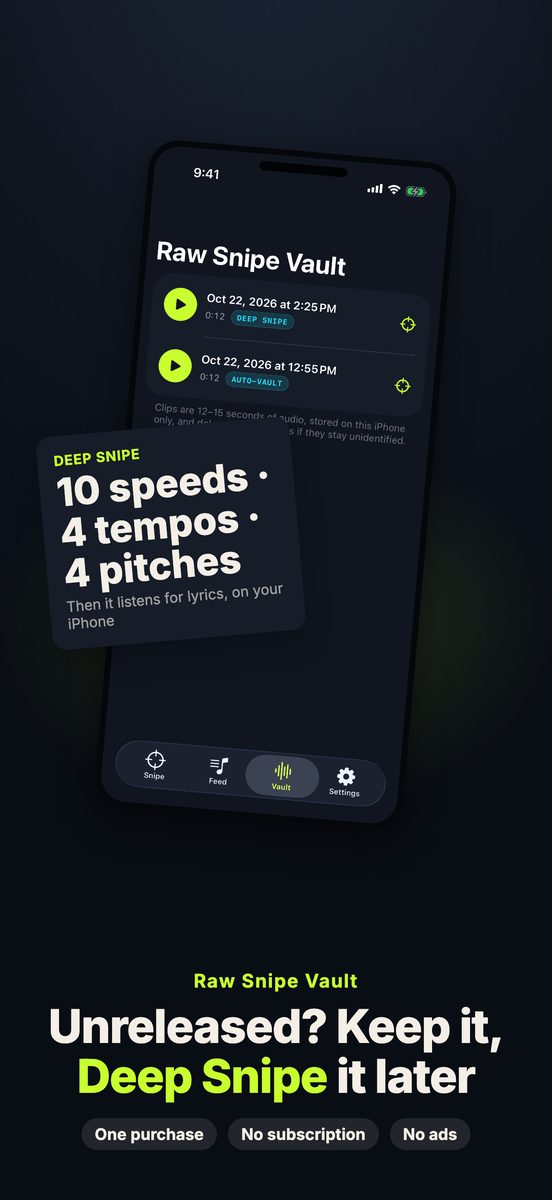
From the App Store listing. Names in it are samples.
When nothing will find it
No tool can match a song that no catalog has. That covers mash-ups cut from several songs, edits buried in effects, unreleased tracks and a creator’s own recordings. For those, the uploader is the only source: check their profile or ask in the comments.
Cost and where it runs
The speed correction, the Vault and Deep Snipe are part of TuneSnipe Pro: one in-app purchase of $7.99 (₹499 in India), with no subscription. The free version identifies songs at normal speed in sessions of up to 5 minutes, and looks up links without limit. TuneSnipe runs on iPhone only, with iOS 18 or later.
Download TuneSnipe on the App Store, or start with how to find a song from a TikTok.
Checked against TuneSnipe 1.0 on 14 November 2026.
Questions, answered
- Why can't Shazam find a slowed + reverb song?
- Slowing a track down lowers its tempo and its pitch, and reverb blurs the sound. The edit no longer sounds like the original recording a catalog knows, so a match often fails, unless the slowed version was itself released.
- How do I find the original of a slowed song?
- Check the video's sound credit and caption, search a line of the lyrics, or use a tool that corrects the speed before matching. TuneSnipe Pro replays the last 8 seconds at corrected speeds from 0.8× to 1.33×, and its Deep Snipe retries kept clips at 10 speeds, 4 tempos and 4 pitches.
- Does it work for nightcore and sped-up edits too?
- Yes. Those are the same problem in the other direction: faster and higher. The same speed correction covers them.
- When will nothing find it?
- When the edit is cut together from several songs, buried in heavy effects, or made from a song no catalog has. Then the uploader is the only source.